
Best Insulation for Texas Weather: What Houston Homeowners Need to Know
Living in Texas means enjoying many benefits: warm winters, outdoor activities, and a growing economy.
However, Texas homeowners also know that the climate can create serious challenges for keeping a home comfortable.
During the summer months, temperatures can remain extremely high for extended periods. In areas like Houston, homeowners must also deal with another factor that affects comfort and energy efficiency:
Humidity.
These conditions place significant demands on residential heating and cooling systems.
Many homeowners invest in larger air conditioning units, smart thermostats, and energy-efficient appliances but overlook one of the most important parts of the home:
The insulation system.
The right insulation helps create a barrier between your indoor environment and the outside climate.
For Texas homes, insulation must do more than slow heat transfer. It should also help address:
- Air leakage
- Humidity concerns
- Uneven temperatures
- Energy waste
- Indoor comfort
What is the best insulation for Texas weather?
The answer depends on the home, but understanding how different insulation options perform in this climate can help homeowners make better decisions.
⸻
Why Texas Weather Creates Unique Insulation Challenges
Not all climates place the same demands on a home.
A house in a cold northern state faces challenges related to keeping heat inside.
Texas homes face a different problem:
Keeping heat and humidity outside.
During summer:
- Outdoor temperatures rise dramatically.
- Attics absorb large amounts of heat.
- Cooling systems work continuously.
- Air leaks allow hot air to enter.
When insulation is inadequate, this heat transfer can make indoor spaces uncomfortable and increase energy consumption.
⸻
The Importance of the Building Envelope
A home’s building envelope is the barrier separating the indoor environment from the outdoors.
It includes:
- Roof
- Walls
- Insulation
- Windows
- Doors
- Air sealing components
A high-performing building envelope helps control:
- Temperature
- Moisture movement
- Air infiltration
Insulation is one important part of this system.
However, the best results often come from combining proper insulation with effective air sealing.
⸻
What Qualities Should Insulation Have in Texas?
Because of the Texas climate, homeowners should consider several factors when choosing insulation.
Thermal Performance
The insulation should help slow heat transfer between the outside and inside of the home.
This is especially important during long summer cooling seasons.
⸻
Air Sealing Ability
Texas homes benefit from reducing unwanted air movement.
Hot, humid outdoor air entering through gaps can make homes less comfortable.
⸻
Moisture Management
In humid areas like Houston, controlling moisture movement is an important consideration.
The insulation choice should match the location where it will be installed.
⸻
Long-Term Performance
Homeowners want insulation that continues performing over time.
Durability and proper installation play important roles.
⸻
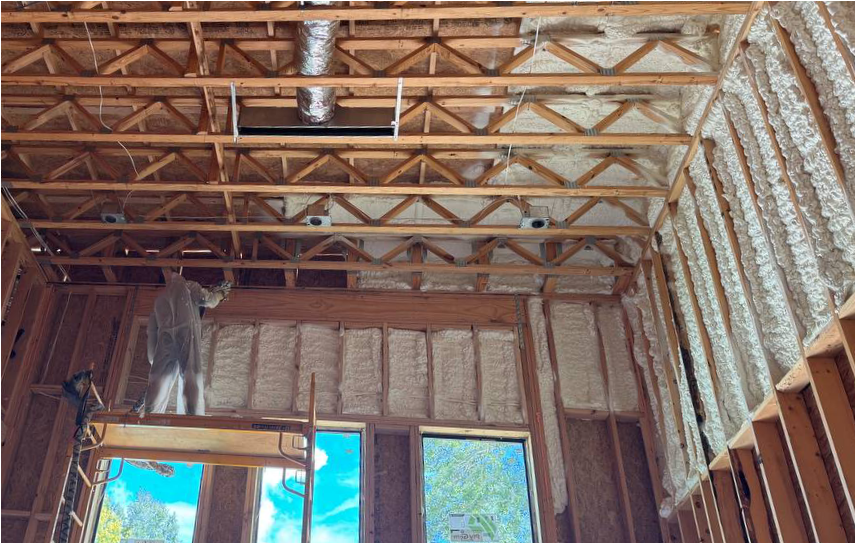
Spray Foam Insulation: A Popular Choice for Texas Homes
Spray foam insulation has become increasingly popular among Texas homeowners because it addresses multiple challenges at once.
When installed correctly, spray foam can:
- Reduce air leakage
- Improve insulation performance
- Seal difficult areas
- Create a more consistent indoor environment
This makes it especially appealing in climates where cooling demands are high.
⸻
Open Cell Spray Foam for Texas Homes
Open cell spray foam is commonly used in residential applications because it expands significantly and fills irregular spaces.
Potential advantages include:
- Excellent air sealing
- Good sound absorption
- Ability to reach difficult areas
- Effective attic applications
Many homeowners choose open cell foam when their primary goals include improving comfort and reducing air movement.
⸻
Closed Cell Spray Foam for Texas Homes
Closed cell spray foam has a denser structure and provides additional benefits.
It offers:
- Higher insulation value per inch
- Greater density
- Strong moisture resistance characteristics
It is often considered for applications such as:
- Exterior walls
- Crawl spaces
- Metal buildings
- Areas where space is limited
⸻
Fiberglass Insulation in Texas Homes
Fiberglass remains one of the most common insulation options.
It is popular because:
- It has a lower initial cost
- It is widely available
- It can provide effective insulation when properly installed
However, fiberglass does not typically provide the same air-sealing capabilities as spray foam.
Installation quality is extremely important because gaps or compression can reduce performance.
⸻
Homeowner Checklist
Does Your Texas Home Need Better Insulation?
☐ Your electricity bills are high during summer
☐ Your upstairs rooms feel much hotter
☐ Your AC runs constantly
☐ Your home feels humid
☐ Some rooms are uncomfortable compared with others
☐ Your attic becomes extremely hot
☐ Your insulation is old or uneven
☐ Your home was built before modern energy standards
☐ You want to improve comfort before replacing your HVAC system
If several of these signs sound familiar, your insulation may need evaluation.